The true arms race: media spending

Right now, you’re probably considering an Amish lifestyle, one with no TV, Internet or direct mail to avoid the election pandemic. If the presidential “debates” haven’t exhausted your attention span, imagine what it will be like before the general election on November 3. Exercising our freedom to vote has spawned non-stop political advertising and media coverage on a national level, but the war for our brains in Wisconsin is in full swing.

Media experts predict the 2016 presidential candidates could spend between $5 billion to $8 billion. That’s billion with a “B.” Most of that money will be spent on television advertising, making the real election winners the companies that own local and national television stations.  In addition to advertising, the trending topic for national news outlets, regional media, and even local media will be the elections and dissecting the tiniest comment or action by any one candidate.

Before the presidential election in 2016, I counseled a client to plan communications activity around the election season. He looked at me like I was an alien, but when his television spots were continually bumped by political ads he finally understood. It’s wise to consider how the elections could affect your business communications, so here are some points to consider.

Despite the megasaurus advertising spending, TV ads have little effect on how undecided voters will fill out their ballots. That’s according to political science experts across the spectrum. And, the slice of undecided voters is relatively small—the battleground is for about 6-11% of the electorate that is undecided.

If you haven’t noticed yet, any method of communications is being used to gain a portion of your mind. Robo-calls, direct mail (yes it still works), Facebook, TV, radio, even ads within popular gaming apps are all butting into your daily life. The response: turn it off. If past elections are any indication, more people will be taking a hiatus from social media, turning off the TV, and pitching the mailers right into the recycling pile. 

As consumers tune out, it might be a good idea to take a break from promotions or advertising for the next month. On November 4, reassess your communications plan and start fresh—unless the millions of mail in ballots give reason for a disputed election and the noise continues through the holidays. What was that saying about “peace on earth?” 
Social media might not be the holy grail

Legacy media still plays a role

One of the best sources of fact-based information I follow is the Pew Research Center for Journalism and Media. Their reports on media usage, current events, and election year issues provide a sane counterpoint to social media surveys and contests. Some recent surveys have restored my faith in legacy media and confirmed my long held suspicions.

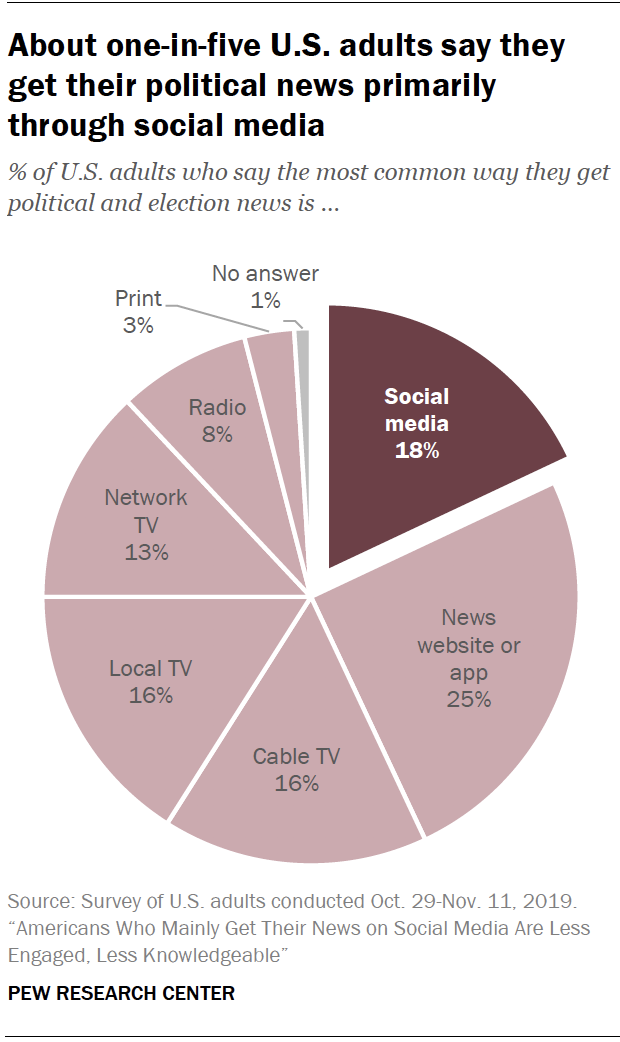
Despite the virulent war of words on social media, it is not the main source of news for most Americans. Less than 20% of us get news from social media, while 45% of us rely on local, network, and cable TV. Sorry newspapers, but you’re only a source of info for 3% of Americans who still subscribe for the grocery coupons.

Among those who trust social media for their news, they are younger and less educated than people who use other platforms. And you wonder why stories about aliens and the Kardashians keep showing up on your Facebook feed.

Next, look at how local news figures into the mix. Almost half of Americans are sourcing information about the pandemic locally—that means radio stations, TV news, maybe even those who are still reading the local paper. And based on research (not opinion) survey respondents indicated they still trust their local news sources.

What does this mean for your business? Increasingly I’m seeing B2B firms place more emphasis on social media as a primary communications platform. It certainly is part of the mix, but should not eclipse a public relations/media relations strategy that reaches out to local and regional legacy media. Regional media won’t give you the daily report of likes and shares that social media delivers, but the credibility factor is huge. Coverage in targeted media outlets gives your organization an endorsement of sorts from an objective, third party—the media.

Leveraging the power of legacy media is more than just blanketing reporters with press releases. It’s about creating a human connection versus a transactional relationship. It’s about understanding what media outlets are looking for in terms of coverage that relates to their audience, and delivering it on their timeline (not yours).  And mostly, it’s about being a savvy consumer of the news and trade news to figure out how your organization or product fits in.

In the meantime, put down that Instagram post and tune into the local news.

For more information on the Pew Research Center, visit this page. 

Oscar C. Boldt in memoriam

With Oscar C. Boldt on the occasion of dedicating a giant crane at the Boldt construction yard, 2012.

It seems everyone has an O.C. Boldt story and I’m no exception. Years ago when I started working with The Boldt Company I was prepping O.C., Tom Boldt, and Bob DeKoch for a cover story for Marketplace Magazine. I had only been working with the firm for about a year and really didn’t know the leadership well.

I did what any reporter would do and I asked O.C. “what is the secret to your success?”

He leaned back in his chair, folded his arms across his chest and very seriously answered: “Everybody else is a bunch of crooks.”

Without missing a beat I said: “Well that may be true, but I would counsel you to not say that to a reporter.”

He answered with a visible twinkle in his blue eyes: “I’m just kidding you. I was testing you to see how you would respond.”

That was about 15 years ago and in the years of working with his wonderful company, I was blessed to learn from him, laugh with him, and listen to the rich trove of stories he had. Stories about how the Fox Cities were built. Stories about buildings on the Lawrence University campus. Stories about how they made it through the Depression when there was no money. And most importantly, stories about where to get the best ice cream.

When I bumped into him in the hallways of the office, he would look at me with intensity and say, “I know if you’re here, you’re costing me money. So what are you doing today to get results?” And I would tell him about a story we were working on, about a case study we were writing, or about a recent story that was published in one of our markets. And he would end our chat with “but are you having any fun?”

And I thought yes, yes I am because I bumped into you today.

As we got to know each other better he asked me where I was from, what my parents did for livings, and he learned that I was part Irish. He was quick to say “My mother always warned me about Irish Catholic girls and I can see in your case she was right.” He never let me forget that.

He and his wife Pat have had a profound impact on me—showing me what true stewardship and community involvement can do for a region. As a former board member of a local arts group, their patronage has been a gift of sustainability to our choir. Seeing them in the audience of a concert meant they not only supported us because it was the right thing to do, but it was something they truly enjoyed.

Over his lifetime, he built far more than buildings–he built community wherever he saw a need. Some of you may not realize this, but there’s a pair of handprints in the concrete just to the left of the main entrance to the Fox Cities Performing Arts Center. When the company was building the PAC, he would lean against the wall just to, as he said, “feel the building.” Years later, when going on a tour of the many buildings Boldt built, a reporter looked at the hand prints, laughed, and said “look at that, somebody put their hands in the wet concrete,” and I told him those hands were very important.

Thank you Oscar for leaving your imprint on so many souls.

You’re getting flamed in the media. Now what?

I’ve heard this more in the last six weeks than any other time in my 40-year career: We need to get positive press coverage OR we need to STOP this media coverage. The time to leverage or squash media attention is not in the middle of a crisis—it depends entirely on what you do with your public relations and media relationships before panic strikes.

Even in a crisis, PR/Media depends on your objectives. Is your long game about building a positive reputation to attract qualified employees? Are you stemming the loss of distributors? Do you want to highlight your product as a solution to a social need? Or do you just want to stay out of the press?

Before you randomly call a TV station to complain/invite coverage, consider these points.

  • Media coverage can be a silent salesman for you. When your organization is featured with positive press, the implied third-party endorsement of independent media carries more weight than a sell sheet or a paid ad.
  • Your distributors and sales team can use media coverage as a touch point to reach potential customers. If you get a great story—email and blog it to the world.
  • Remember to share the story on multiple platforms. Share links in emails, outbound marketing, social media channels, internal communications and more.
  • Consistent media coverage reaches potential employees—or their mothers. Becoming an employer of choice depends on making a positive impression on people looking for work and their family members egging them on.
  • Killing a story or changing the narrative is usually not successful unless there’s an existing relationship with a media outlet. Simply calling up and claiming you’ve been treated unfairly is a trigger to keep that negative press going. You need to understand what is motivating the media outlet and understand how you can provide another angle on your story.
  • Don’t lie. If you have bad press and it’s true, you have no choice but to own it. Good reporters have refined B.S. detectors and know when someone is covering up the truth. Admit your mistakes, work to correct them, and share your path forward with trusted media outlets. Hiding or saying “no comment” will only prolong the news cycle.

The one final point is to be a wise media consumer. Watch/read/listen to your regional media outlets and be aware of the news cycle and the ongoing coverage. Be wary of national media platforms that create click bait by interviewing politically charged bloviators who mask opinion for objective coverage.

Want more help? If you’re interested, find me at mkathrynschmidt@gmail.com.

The real pandemic: media hype

There’s no cure. There’s no vaccination. There are no protective measures—short of unplugging.

I’ve been asked by my clients why the media is in a feeding frenzy over COVID-19 and it all boils down to click bait. Editors are crafting tittilating headlines and updates to get you to click on a tweet that takes you to their website. It’s all about social media hits, web traffic and trending topics—editorial judgement be damned.

And it all starts at the top—networks and legacy journalism platforms are feeding the fever. This morning the first 15 minutes of the network news was pandemic centered, and in broadcast news 15 minutes is an eternity. Then it trickles down to local media outlets who are scouring their markets for people related to those in quarantine, residents cancelling cruises, businesses grounding their workforce, and schools shutting down.

Why? A few reasons:

  • Consumers have a 140-character attention span. If a news story requires you to invest time to read, understand, and contemplate content, it won’t make the editorial cut. A school referendum will have more long-range consequences for a community, but tax levies can be complicated and few reporters have the creativity to actually tell a story (Storytelling: the new buzz of 2020 that’s actually been around for decades in newsrooms). It’s easier to click on a headline about cancelling cruises than read about how schools are funded.
  • Fear is sexy. When media outlets leave with you with more questions than answers, you will access their platforms more frequently to stay updated.
  • Editorial judgement has been replaced by trending stories. Editorial judgment means experienced journalists would consider all the issues on any one day, then select those that had the biggest impact on their audience, the potential for future impact, or topics that were unusual (read “man bites dog). Now, content editors first check social media for trending topics and use that to guide how stories are selected and which ones get the most play. The social media habits of people clicking on the Kardashians are influencing what is “news” in our local communities.

I would never advocate ignoring social platforms as communications channels—they are here to stay just as TV was in the 1950s. But somewhere in this frenzy perhaps objective reporting could give us a wider perspective.  Perhaps editorial staffs could remember that citizens learn little if all media does is parrot the flavor of the day.

Perhaps the best news out of this issue is the federal government may delay April 15 tax filings. Think that’ll make the Twitter feed?

Do this before you jump into social media

twitterAt the risk of getting flamed on my Twitter account, I’m going to utter social media blasphemy: I’m not completely convinced social media is the communications messiah for some businesses. I’ve worked with a lot of business-to-business clients over the years, and in the rush to set up a Twitter account, many forget to take care of the basics of communications.

If your business targets a consumer market, then Facebook, Twitter, Instagram, YouTube are must-haves. But if you are selling parts to a manufacturer, or if you’re selling services to an industrial client, first take a good, hard look at some communications basics.

For most industrial & manufacturing busineses, trade associations, trade magazines/websites, and professional organizations are still the basics of communications. Fundamental tools like sell sheets, case studies and testimonials are the first tools you need to tell your story.

So before you open up an Instagram account, consider these pointers for online communications in the B2B world.

Know how your customer consumes information. If your customer is like a normal professional, they have a full in-box, a full voice mail, and they spend their day putting out fires. There’s a stack of professional journals flagged for review on an airplane while they’re traveling to a customer location. Facebook is not on their agenda and, if they are checking websites, its likely on their smartphone.

Triage your website content. Assuming you have a website (and you should), review your content and make sure you’re communicating in an understandable voice. If your only customer is a materials engineer, I’ll give you a free pass to write on a professorial level. But if you’re communicating with a range of customers in an industry, be sure your message is clear—which means limiting jargon, abbreviations and acronyms. Clearly explain how your product/service is different from competitors and the benefits you will provide your customers.

Tell a story. We are bombarded by thousands of messages daily and the best way to grab someone’s attention is to tell a story about your business. Perhaps it’s a case study of how you solved a problem for a customer or why you started your business, but communicate something beyond listing your products.

Make your website mobile. Most industrial and manufacturing professionals are running their business off of their smart phones and if your website is not optimized for that platform, you’re losing business.

Use your website as a publishing platform. Your website should not be a static document—it should be a content hub. This means you need to update information regularly and the most common way to do that is through a blog. Once you develop topical blog content, you can drive target consumers and trade journalists to learn more about your company, products and services through a judicious use of social media.

If you do nothing else, do LinkedIn. I used to dismiss LinkedIn as a boring version of Facebook but changed my tune once I invested time into it. That’s the key—you only get out of LinkedIn what you put in. Individuals must participate and that means you or key team members in your organization must take the time to develop a robust profile, then start interacting on the platform. Many industries are surprised by the professional groups, alumni organizations, events and discussions that can be found on LinkedIn—but only if you participate.

One more reality of LinkedIn—this is a platform that is based on the individual, not an organization. People link to people first and through those personal connections build a network. Often the biggest hurdle is to convince your team members they need to take time for LinkedIn, but you don’t need to invest an hour a day; start with investing one hour a week.

Before you rush into social media because your competitor is tweeting, stop and consider if you’ve done the basic blocking & tackling of talking to your customers. If all of this gives you a massive headache, drop me a line at mkathrynschmidt@gmail.com and we’ll talk. Or tweet.

.

I can tell if you’re lying

Good reporters are pretty good at sniffing out a liar. Its because being lied to is a big part of their job. They ask uncomfortable questions in an effort to uncover the truth and if they’re getting really close to a sticky truth, their subjects will divert, evade, and maybe even fake an answer.

After years of interviewing sources and covering the legislature, I became adept at knowing when the interviewee was lying. I think most of this skill was developed by interviewing politicians, but don’t quote me on that correlation.

Experienced reporters develop a second sense to know when the interview is hiding information. It’s part reading body language, part knowing the issue, part asking the right questions, and part getting the subject comfortable and catching them off guard.

It was easier in the pre-internet world to get away with a half-truth. Back then reporters had to cover a beat or really research an issue to know when one person’s reality strayed from the truth. But today, there are too many ways to fact check information with one Google search or find unauthorized cell phone videos on youtube.

So here’s the advice from a professional: don’t lie.

That said you don’t have to divulge the entire truth of your financials (especially if you’re a privately owned company). Before giving that feature story on your corporate performance, before being interviewed on your annual goals, before you make your safety stats public, do some homework.

  1. Research the media outlet and read stories the reporter has published in the past.
  2. Be clear on your key messages. This may require you to do some prep work rather than ripping these off the top of your head.
  3. Anticipate potentially negative issues a reporter may ask and prepare answers for those.
  4. Ask the reporter for questions prior to the interview. Be advised: they are not required to give you the questions and even if they do, they may not follow the script.

You don’t have to put your hand on the Bible and swear to tell the whole truth, but telling no truths will live forever on the Internet.

If you’re interested, find me at mkathrynschmidt@gmail.com.

Sometimes it’s best to just stop talking

In our over communicated, over networked world, we are hard wired to fill the void with information. Self-published video missives abound on YouTube and there’s a talk show for every imaginable topic.

But for grown-up businesses, sometimes the best thing to do is stop talking. In the quest of building a positive image, there is a zeal for over explaining. A former client could not help himself and spilled the beans “confidentially” to a reporter, then was astonished when the information showed up in print.

Unless you have a long relationship with a reporter and have built mutual trust, information is never off the record.

A best practice is to write down key messages and really embrace them so you can confidently and succinctly communicate. Unless you’re an experienced media source, don’t think you’re just going to riff these off with no practice.

Most people who are interview subjects are extremely uncomfortable with silence. The natural reaction in an interview is to keep the conversation going—which is exactly what experienced reporters want.  Be comfortable with stating your response, then stop talking. It’s up to the reporter to ask follow up questions and dig deeper.

Interested in learning more? Drop me a message at mkathrynschmidt@gmail.com.

How to get news coverage in three easy steps

  1. Do something illegal.
  2. Do something immoral.
  3. Do something stupid

And as a bonus, definitely put it all on social media.

As a former reporter and news producer, these are three sure-fired ways to get media coverage. If you’re not inclined to embarrass yourself or your company, try some other suggestions for positive coverage:

  1. Research targeted reporters and editors and find out the kinds of stories that they like to cover. Don’t bother pitching story ideas about financial success to a reporter with a diversity beat—but do figure out how a diverse culture creates financial success. Know your gatekeepers and find stories that trigger their interest.
  2. Is your company first/only/best at a product or service? Don’t discount the news value of being first to market.
  3. What is the story behind a product/service? Find those storytelling opportunities and present case studies that show how the end user moved the needle with your company’s help.
  4. How many experts do you have? God help you if you have a company full of self-appointed experts, but surely there are a few legitimate experts in your field. These thought leaders would be excellent columnists for media platforms.
  5. Are children or animals involved? Sorry for pandering to the media, but if kids or furry creatures are engaged in your business it increases the chances of coverage.

Interested in learning more? Drop me a message at mkathrynschmidt@gmail.com

Freedom of the press and boys behaving badly

Congress shall make no law respecting an establishment of religion, or prohibiting the free exercise thereof; or abridging the freedom of speech, or of the press; or the right of the people peaceably to assemble, and to petition the Government for a redress of grievances.

Let’s talk about freedom of the press—it’s an inalienable right we all share. But when there is bad behavior on both sides, we start to question first amendment rights and access to information. And the consequences thereof.

I listened to the President’s press conference on radio shaking my head in disbelief about the behavior of the press andthe President’s response. The reporters in question exhibited bad behavior, but to hear a sitting President call anyone a “rude, terrible person” denigrates the office.

To get to the rarified air of the White House press corps, journalists and media outlets have to go through approval by the Standing Committee of Correspondents, an association of reporters that approves press passes for Congress. There are background checks, secret service clearance, verification that media outlets are legitimate, and annual review of these checkpoints.

Putting those credentials in jeopardy is generally a bad idea if reporters want to keep their jobs and editors want to maintain access. My friends who are news directors and editors would not condone belligerent behavior—unless it’s on the journey to a truly big story.

For those of you who are civilians and aren’t familiar with the press up close and personal, a few realities. Aggressive, determined reporters are usually rewarded because they get the story. It’s a noxious side effect of our 24/7 news cycle fueled by insta-media online and on cable. There’s always a fine line between a pushy reporter and a hardened journalist.

Frankly, I think CNN’s Jim Acosta performed for his colleagues’ cameras simply to provoke the response from President Trump that he anticipated. There is no greater stage than one that has the potential to reach millions of people online and on air.

It is appropriate for a President (or any person being interviewed) to stop a line of questioning and move on. Usually this is done with a certain amount of professional behavior instead of personally attacking someone. To tell a reporter he/she is a terrible person, then level charges of racism against another reporter, and lash out about “fake news” is petulant and does no honor to the office.

Is this unprecedented behavior? Only because social media amplifies the injustices.

Donald Trump does not have a monopoly on bad relationships with the media. Just look back at Richard Nixon’s war with the Washington Post (for those of you under 40, google “Watergate”). Franklin D. Roosevelt was convinced the newspapers were out to get him. His cousin Theodore was one of the first commanders in chief to use media leaks and spin to manipulate information. Since printed newspapers were considered “new media,” journalists have been banned from the White House and kicked out of the capitol press corps. This relationship is nothing new.

But when access is squeezed repeatedly, we should wake up and take notice. Are journalists being cut off because of personal behavior or because those in power don’t want to consider questions to which the public demands answers ? When elected officials who represent all of us demonstrate repeated disdain of a free press, we need to pay attention.

The American press goes where we do not—to the courts, the state legislatures, the city council meetings, the police departments. Reporters are our eyes and ears, the checks and balances that in some cases hold our public institutions to higher standards. We would like to believe our public institutions always operate with integrity and public interest at heart—but history proves otherwise.

The press is the “fourth estate.” It’s a term that places the press alongside the three branches of government: legislative, executive, and judicial. It gives the press the role of “watchdog” and gives reporters and editors unofficial job description of overseer.

When the press is repeatedly prevented from this role, ask yourself: is the fox watching the hen house?

If you’re interested, find me at mkathrynschmidt@gmail.com.